
Neural Networks have become one of the most important technologies behind modern artificial intelligence. From voice assistants and recommendation systems to image recognition and self-driving technology, neural networks help computers understand information and make intelligent decisions. Although the technology may sound complicated, the basic idea is surprisingly easy to understand: a neural network learns patterns from data and uses those patterns to produce useful results.
As artificial intelligence continues to develop, understanding Neural Networks is becoming increasingly valuable for students, businesses, developers, and anyone interested in technology. This article explains what neural networks are, how they work, where they are used, their major benefits and limitations, and what the future may look like.
What Are Neural Networks?
A neural network is a type of machine learning model inspired loosely by the way biological neurons communicate in the human brain. Instead of being programmed with a specific instruction for every possible situation, a neural network can learn from examples.
A typical neural network contains interconnected processing units called artificial neurons or nodes. These nodes are organized into different layers. The first layer receives information, the middle layers process it, and the final layer produces an output.
For example, imagine a system designed to identify whether an image contains a cat. The network can be trained using thousands of images labeled as “cat” or “not cat.” During training, it identifies visual patterns such as shapes, edges, textures, and other features. Over time, the network adjusts itself so that it becomes better at recognizing cats in new images.
The key point is that neural networks learn from data rather than relying entirely on manually written rules.
How Do Neural Networks Work?
Neural Networks generally consist of three main types of layers: the input layer, hidden layers, and output layer.
The input layer receives the original information. Depending on the task, this information could be an image, a sentence, numbers, audio, or other types of data.
The hidden layers perform calculations on the information received from the previous layer. Each artificial neuron assigns importance to different pieces of information using values called weights. An activation function then helps determine whether a neuron should pass a particular signal forward.
Finally, the output layer provides the result. For instance, a neural network analyzing an email might determine whether the message is likely to be spam.
During training, the network compares its prediction with the correct answer. If the prediction is wrong, the model calculates an error and adjusts its internal weights. This process is repeated many times. Through this continuous adjustment, the network gradually improves its performance.
One of the most important techniques involved in this learning process is called backpropagation. It allows the network to determine how much different weights contributed to an error and then update them accordingly.
Types of Neural Networks
There are several types of neural networks, and each is designed to handle particular kinds of problems.
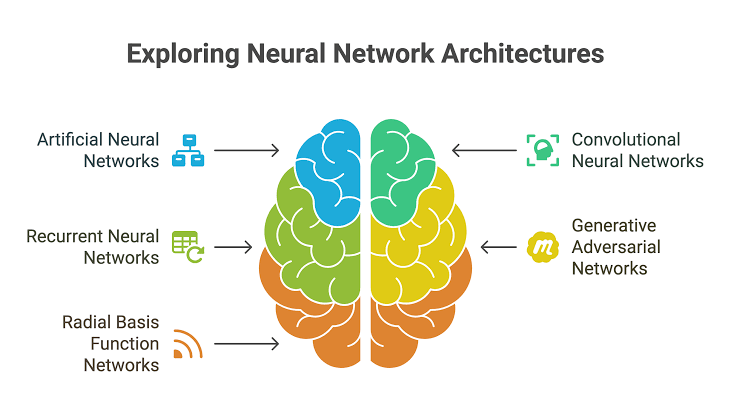
Feedforward Neural Networks are among the simplest forms. Information moves from the input layer through the hidden layers to the output without looping backward. They are useful for basic classification and prediction tasks.
Convolutional Neural Networks (CNNs) are particularly effective for processing images and visual information. They can identify patterns such as edges, shapes, and objects, which makes them useful in facial recognition, medical imaging, and computer vision.
Recurrent Neural Networks (RNNs) were designed to work with sequential information. They can consider previous information when processing new data, making them useful for certain language, speech, and time-series applications.
Modern artificial intelligence also relies heavily on transformer-based architectures, which have become particularly important for language processing and other tasks involving relationships between different parts of a sequence.
The choice of neural network depends on the type of data and the problem that needs to be solved.
Common Applications of Neural Networks
Neural Networks are now used across many industries. One of their most visible applications is in image recognition. Technology companies use neural networks to recognize objects, faces, scenes, and other visual features in photographs and videos.
They also play a major role in natural language processing. Applications such as translation tools, chatbots, text-generation systems, grammar assistants, and search technologies can use neural network models to understand and generate human language.
Another important area is healthcare. Neural networks can assist with analyzing medical images, identifying patterns in patient data, and supporting research. They do not replace medical professionals, but they can provide useful analytical assistance when properly designed and validated.
In finance, neural networks can be used for fraud detection, risk analysis, forecasting, and customer behavior analysis. Financial institutions can analyze large amounts of data to identify unusual patterns that might otherwise be difficult to detect.
The automotive industry also uses neural networks for driver-assistance systems, object detection, road-scene understanding, and other aspects of autonomous driving research.
Even entertainment platforms use them. Streaming services and online stores can analyze user behavior to recommend movies, songs, products, or other content that may be relevant to individual users.
Benefits of Neural Networks
One major advantage of Neural Networks is their ability to learn complex patterns. Traditional computer programs often require developers to specify detailed rules. Neural networks can discover many useful relationships directly from training data.
Another benefit is their ability to handle large and complicated datasets. When sufficient high-quality data and computing resources are available, neural networks can perform extremely well on tasks involving images, language, sound, and other forms of information.
Neural networks can also improve as they receive better training. With an appropriate model, useful data, and careful optimization, performance can increase significantly.
They are also highly versatile. The same general concept can be adapted for different applications, including classification, prediction, recommendation, recognition, and generation.
Challenges and Limitations
Despite their impressive capabilities, Neural Networks are not perfect.
One major challenge is the need for large amounts of quality data. A model trained on incomplete, inaccurate, or biased information may produce unreliable results. The quality of the training data can have a major effect on the quality of the model.
Another concern is computational cost. Training large neural networks can require powerful processors, significant memory, electricity, and considerable time. This can make advanced models expensive to develop and operate.
Neural networks can also be difficult to interpret. In some situations, it may be challenging to explain exactly why a model produced a particular prediction. This “black box” characteristic can be a serious concern in areas where transparency is important.
There is also the risk of overfitting. A model may perform extremely well on the data it was trained on but struggle with new information. Techniques such as regularization, better datasets, and careful evaluation can help reduce this problem.
Neural Networks vs. Traditional Machine Learning
Neural networks are a part of machine learning, but not all machine learning systems use neural networks.
Traditional machine learning methods can work very well when datasets are structured and the important features can be identified relatively easily. Algorithms such as decision trees and linear models are often simpler to train and easier to interpret.
Neural networks become especially useful when the data is complex or unstructured, such as images, audio, and natural language. They can automatically learn useful representations from raw or minimally processed data.
However, bigger and more complicated does not always mean better. The right approach depends on the specific problem, available data, computing resources, and desired outcome.
The Future of Neural Networks
The future of Neural Networks is likely to involve more efficient, capable, and specialized systems. Researchers are working on models that can learn more effectively while using fewer computational resources.
Another important direction is the development of smaller models that can operate directly on smartphones, cameras, vehicles, industrial machines, and other devices. This can reduce the need to send every piece of information to a remote server.
Improving reliability and reducing bias will also remain important. As neural networks become more deeply integrated into everyday applications, developers and organizations will need to focus not only on performance but also on safety, privacy, transparency, and responsible use.
Neural networks are unlikely to disappear as artificial intelligence evolves. Instead, they will continue to develop alongside new architectures, training techniques, and computing technologies.
Frequently Asked Questions
1. What is a neural network in simple words?
A neural network is a computer model that learns patterns from examples. It processes information through interconnected artificial neurons and uses what it learns to make predictions, classifications, or other decisions.
2. How do Neural Networks learn?
Neural Networks learn by analyzing training data and comparing their predictions with the correct answers. They adjust internal weights based on their errors, gradually improving their performance through repeated training.
3. Where are Neural Networks used?
They are used in many areas, including image recognition, speech processing, language translation, recommendation systems, fraud detection, healthcare analysis, autonomous driving research, and generative artificial intelligence.
4. Are Neural Networks the same as artificial intelligence?
No. Neural Networks are a technology used within artificial intelligence and machine learning. Artificial intelligence is the broader field, while neural networks are one important approach for creating systems that can learn from data.
5. Why do Neural Networks need large amounts of data?
Large datasets can provide more examples for a model to learn from. For complex tasks, having diverse and high-quality data can help a neural network recognize patterns and perform better on new information.
6. What is deep learning?
Deep learning is a branch of machine learning that commonly uses neural networks with multiple layers. These deeper architectures can learn increasingly complex patterns from data and are widely used for language, vision, speech, and other applications.
7. Can Neural Networks make mistakes?
Yes. Neural networks can produce incorrect results, especially when they are trained on poor-quality data, encounter situations that differ from their training data, or are not properly designed and evaluated. Human oversight and testing remain important.
8. What is the future of Neural Networks?
The technology is expected to become more efficient, specialized, and capable. Future developments may focus on smaller models, better reasoning and learning methods, improved reliability, lower computing requirements, and safer applications of artificial intelligence.
Conclusion
Neural Networks have transformed the way computers process and learn from information. By identifying patterns in large datasets, they can perform tasks that once required extensive human programming. Their applications range from healthcare and finance to language processing, image recognition, entertainment, and transportation.
At the same time, neural networks have important limitations. They require suitable data, computing resources, careful testing, and responsible development. Understanding both their capabilities and weaknesses is essential for using the technology effectively.
As artificial intelligence continues to advance, Neural Networks will remain an important foundation of many intelligent systems. Whether you are a beginner learning about AI or a professional exploring new technologies, understanding how neural networks work provides a strong starting point for exploring the wider world of machine learning.