
Artificial intelligence is becoming an important part of our everyday lives. From virtual assistants and online shopping recommendations to healthcare systems and self-driving vehicles, AI is changing the way people work, communicate, and make decisions. These technologies offer many opportunities, but they also raise important questions about privacy, fairness, safety, and accountability. This is where Responsible AI becomes essential.
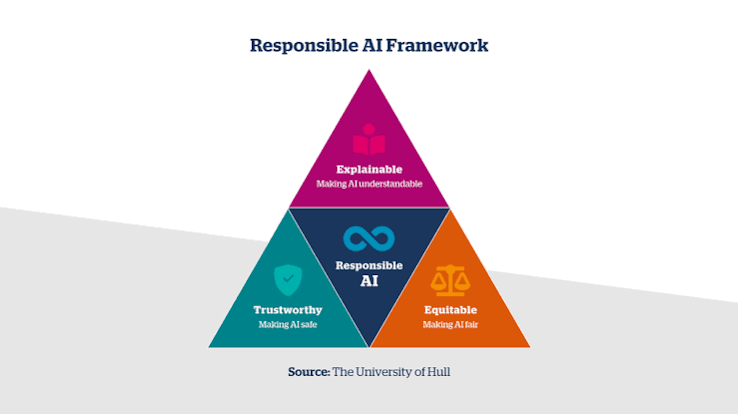
Responsible AI refers to the development and use of artificial intelligence in ways that are ethical, transparent, safe, and fair. It focuses on ensuring that AI systems benefit people without causing unnecessary harm. As businesses, governments, and individuals increasingly depend on intelligent technologies, responsible practices are becoming more important than ever.
The goal is not simply to build powerful AI systems. It is to create technology that people can trust and use with confidence. By considering human values and potential risks from the beginning, organizations can make AI more beneficial for society.
What Is Responsible AI?
Responsible AI is an approach to designing, developing, deploying, and managing artificial intelligence systems with careful attention to their impact on individuals and communities. It encourages organizations to consider ethical concerns throughout the entire life cycle of an AI system.
For example, a company using AI to review job applications should ensure that its system evaluates candidates fairly. It should not disadvantage applicants because of their gender, age, ethnicity, disability, or other irrelevant personal characteristics. Similarly, a hospital using AI to support medical decisions should evaluate the system carefully and ensure that qualified healthcare professionals remain involved in important decisions.
Responsible AI combines technical practices with human judgment. It involves creating clear policies, testing systems, protecting personal information, monitoring performance, and providing ways to challenge harmful or incorrect outcomes.
Rather than treating responsibility as an optional feature, organizations should consider it a fundamental part of successful AI development.
Why Responsible AI Matters
AI systems can process large amounts of information and identify patterns faster than humans in many situations. However, their results are not always accurate or fair. An AI system can produce misleading information, repeat existing social biases, or make decisions that are difficult for people to understand.
These problems can have serious consequences when AI is used in areas such as employment, education, banking, healthcare, and law enforcement.
Responsible AI helps reduce these risks by encouraging careful planning, regular testing, and human oversight. It also helps organizations protect their reputations and build stronger relationships with customers.
Trust is particularly important because people are more likely to accept and benefit from technology when they understand how it works and believe their interests are being considered.
For businesses, responsible practices can also support long-term innovation. Identifying risks early may prevent expensive mistakes, regulatory problems, and damage to customer confidence.
Key Principles of Responsible AI
- Fairness and Inclusion
Fairness is one of the most important principles of Responsible AI. An AI system should not unfairly discriminate against individuals or groups.
AI models learn from data, and that data may reflect existing inequalities. If a recruitment system is trained on historical hiring records that favor certain candidates, it may reproduce those preferences when evaluating new applications.
Organizations can reduce this risk by using representative datasets, evaluating model performance across different groups, and involving people with diverse perspectives in the development process.
Fairness does not always mean treating every situation identically. Sometimes, different users need different forms of support to receive equitable treatment. Regular assessments can help identify whether an AI system creates disadvantages for particular communities.
- Transparency and Explainability
People should receive meaningful information about how AI systems are used and how their decisions may affect them.
Transparency involves explaining when AI is involved in a process, what information it uses, and what its limitations are. Explainability goes further by helping people understand the reasons behind a particular result.
For example, if a financial institution uses AI to assist with loan applications, applicants should have access to understandable information about important factors influencing the decision.
Not every AI model can provide a simple explanation of its internal calculations. However, organizations can still document their systems, communicate their limitations, and provide clear explanations of their decision-making processes.
Greater transparency helps users make informed choices and makes it easier to identify mistakes.
- Privacy and Data Protection
AI systems often depend on large quantities of data, including information that may be personal or sensitive. Protecting this information is essential for responsible development.
Organizations should collect only the data they genuinely need, obtain appropriate consent where required, and follow applicable privacy laws. They should also use security measures such as encryption, access controls, and secure data storage.
Personal information should not be collected or shared carelessly simply because it might improve an AI model.
For instance, an AI-powered health application should handle medical information with particular care. Users should understand how their information is collected, processed, stored, and shared.
Strong privacy practices protect individuals and help establish confidence in AI-powered services.
- Accountability and Human Oversight
AI systems should not remove responsibility from the people and organizations that create or use them.
Accountability means that clear responsibilities exist for monitoring AI performance, addressing errors, and responding when harm occurs. Organizations should identify who is responsible for approving a system, reviewing its decisions, and managing potential problems.
Human oversight is especially important in high-impact situations. AI can provide useful recommendations, but it should not automatically replace professional judgment when decisions may significantly affect people’s lives.
For example, an AI tool may help a doctor identify possible signs of disease in medical images. However, qualified medical professionals should evaluate the findings alongside other relevant evidence.
Keeping humans involved helps ensure that decisions consider context, experience, and individual circumstances.
- Safety, Reliability, and Security
Responsible AI systems should perform reliably under expected conditions and be designed to minimize foreseeable harm.
Developers need to test their models before release and continue evaluating them after deployment. AI performance can change when the data, environment, or user behavior changes.
Security is equally important. AI systems may face malicious inputs, unauthorized access, data manipulation, or other attacks. Organizations should identify these threats and establish appropriate safeguards.
Generative AI presents additional challenges because it can produce convincing but incorrect information. Users should be made aware of these limitations, and important outputs should be verified when accuracy matters.
Reliable AI requires ongoing maintenance rather than a single successful test.
Applications of Responsible AI Across Different Industries
Responsible AI can improve many industries when it is implemented carefully.
In healthcare, AI can support medical imaging, help identify health risks, and assist with administrative tasks. Responsible implementation requires clinical validation, privacy protection, and appropriate professional supervision.
In education, AI-powered learning tools can adapt lessons to students’ needs and provide additional practice. However, schools must protect student information and ensure that automated assessments do not unfairly limit educational opportunities.
In finance, AI can help detect suspicious transactions, identify unusual patterns, and support risk assessment. Financial organizations need to monitor these systems for bias and provide appropriate explanations for consequential decisions.
In manufacturing, AI can improve quality control, predict equipment failures, and enhance workplace safety. Companies should evaluate system reliability and consider how automation affects employees.
In customer service, AI assistants can answer routine questions and provide support around the clock. Businesses should make it clear when customers are interacting with AI and offer access to human assistance when necessary.
Across these industries, the central principle remains the same: technology should solve real problems while respecting people’s rights and interests.
Challenges in Implementing Responsible AI
Although Responsible AI offers clear benefits, putting its principles into practice can be challenging.
One major difficulty is biased or incomplete data. Developers may not always have access to representative information, making it harder to evaluate whether a model works fairly for different populations.
Another challenge is the complexity of modern AI systems. Some models are difficult to interpret, which can make it harder to explain their outputs or identify the causes of errors.
Organizations may also face limited budgets, a shortage of skilled professionals, and uncertainty about how to measure ethical performance. Smaller businesses, in particular, may struggle to establish comprehensive testing and governance processes.
Rapid technological development creates additional pressure. AI tools can change quickly, while policies, regulations, and organizational practices may take longer to adapt.
These challenges do not make Responsible AI impossible. Instead, they demonstrate why organizations need clear standards, ongoing education, multidisciplinary teams, and continuous improvement.
How Organizations Can Adopt Responsible AI
Organizations can take several practical steps to make AI development more responsible.
First, they should establish clear principles and policies that explain how AI may be developed and used. These policies should identify acceptable uses, restricted applications, and responsibilities for managing risks.
Second, teams should evaluate potential harms before deploying a system. This assessment should consider privacy, fairness, safety, security, and the possible consequences of incorrect decisions.
Third, organizations should use suitable datasets and test their models under different conditions. Testing should examine accuracy, limitations, and differences in performance across relevant user groups.
Fourth, employees should receive training that helps them understand both the benefits and risks of AI. Responsible implementation requires cooperation among technical specialists, managers, legal professionals, and affected stakeholders.
Fifth, organizations should monitor AI systems after launch. They should establish reporting channels, investigate problems, update models when necessary, and maintain records of important decisions.
Finally, organizations should communicate honestly with users. Clear information about AI capabilities, limitations, and data practices allows people to make better-informed decisions.
These steps can make responsibility a practical part of everyday business operations rather than merely a statement of good intentions.
The Future of Responsible AI
The future of AI will depend not only on technological progress but also on the choices people make about how these systems are designed and controlled.
As AI becomes more capable, responsible development will require stronger collaboration among researchers, businesses, governments, educators, and communities. International cooperation may also help establish consistent expectations for safety, privacy, fairness, and accountability.
Emerging technologies, including autonomous AI agents and increasingly capable generative models, will create new opportunities as well as new risks. Organizations will need to evaluate these systems carefully, especially when they can take actions independently or influence important decisions.
Regulations and technical standards will continue to develop, making it important for businesses to stay informed about relevant requirements. At the same time, compliance alone may not address every ethical concern. Organizations should also consider the broader effects of their technologies on people and society.
The most successful AI systems are likely to be those that combine technical capability with reliability, responsible governance, and respect for human needs.
Conclusion
Responsible AI is essential for ensuring that artificial intelligence develops in ways that benefit society. It brings together fairness, transparency, privacy, accountability, safety, and human oversight to help reduce risks and build trust.
From healthcare and education to finance and manufacturing, responsible practices can help organizations use AI more effectively while protecting the people affected by its decisions.
Achieving Responsible AI requires continuous effort. Developers must test their systems, businesses must establish clear policies, and users must understand the limitations of AI-generated results. Governments and communities also have important roles in shaping appropriate safeguards.
Ultimately, the purpose of Responsible AI is not to slow innovation but to guide it in a positive direction. By putting human well-being at the center of technological progress, society can work toward a future in which artificial intelligence is not only powerful and efficient but also fair, trustworthy, and beneficial for everyone.