
Introduction
Artificial intelligence is changing the way people live, work, and interact with technology. From chatbots and virtual assistants to healthcare systems and financial services, AI has become an important part of everyday life. Businesses use it to improve productivity, analyze information, automate repetitive tasks, and make better decisions. However, as AI technology continues to develop, questions about its safety, fairness, privacy, and reliability are becoming increasingly important.
This is where AI Governance comes into play. It provides a framework of policies, rules, responsibilities, and practices that help organizations develop and use artificial intelligence responsibly. The goal is not to slow down innovation but to ensure that AI systems benefit people without creating unnecessary risks.
As more organizations adopt AI-powered tools, understanding AI governance is becoming essential for business leaders, technology professionals, policymakers, and everyday users.
What Is AI Governance?
AI governance refers to the policies, processes, standards, and controls used to manage artificial intelligence throughout its lifecycle. It covers everything from designing and developing an AI system to testing, deploying, monitoring, and eventually retiring it.
The main purpose of AI governance is to ensure that AI systems operate safely, fairly, transparently, and in accordance with relevant laws and ethical principles.
For example, imagine a company using an AI tool to screen job applications. If the system consistently favors certain candidates because of biased training data, it could create unfair hiring practices. A strong governance framework would require the company to test the system for bias, review its decisions, protect applicants’ information, and provide human oversight where necessary.
In simple terms, AI governance helps organizations answer three important questions: Is the AI system safe to use? Does it treat people fairly? And who is responsible if something goes wrong?
Why Is AI Governance Important?
The growing use of artificial intelligence has created new opportunities, but it has also introduced risks that organizations cannot afford to ignore. Without proper oversight, AI systems may produce inaccurate information, expose sensitive data, reinforce existing inequalities, or make decisions that negatively affect individuals and communities.
AI governance helps organizations identify these risks before they become serious problems. It establishes clear responsibilities and creates procedures for evaluating how AI systems perform in real-world situations.
Another important benefit is trust. Customers are more likely to feel comfortable with AI-powered services when they understand how their information is handled and know that appropriate safeguards are in place.
AI governance can also protect an organization’s reputation. A poorly managed AI system may lead to financial losses, legal challenges, or public criticism. By establishing clear standards and accountability, businesses can reduce these risks while continuing to explore new technological opportunities.
Key Principles of AI Governance
Effective AI governance depends on several important principles. These principles guide organizations in making responsible decisions throughout the development and use of AI systems.
1. Transparency and Explainability
Transparency means providing clear information about how an AI system is used, what it is designed to do, and where its limitations lie. Explainability goes a step further by helping people understand the reasons behind important AI-generated outcomes.
For instance, if a bank uses AI to evaluate loan applications, applicants and relevant staff should have access to meaningful information about the factors influencing a decision. The explanation does not always need to reveal every technical detail, but it should provide enough information to support understanding and appropriate review.
2. Fairness and Bias Prevention
AI systems learn patterns from data, and that data may contain historical biases or incomplete representations of different groups. If these problems are not addressed, AI can produce unfair results.
Organizations should evaluate their training data, test systems across relevant groups, and regularly review outcomes for signs of discrimination. Fairness should be considered from the beginning of development rather than treated as an afterthought.
3. Privacy and Data Protection
Many AI systems depend on large amounts of data, including information that may be personal or confidential. Protecting this information is therefore a central part of responsible AI management.
Businesses should collect only the data they genuinely need, restrict access to sensitive information, and follow applicable privacy laws. They should also explain how data is used and establish appropriate retention and deletion practices.
4. Accountability
Accountability means that people and organizations remain responsible for the AI systems they create, purchase, or use. Companies should clearly assign responsibility for approving AI applications, monitoring their performance, investigating incidents, and correcting problems.
An organization should never assume that a harmful decision is acceptable simply because an algorithm produced it.
5. Safety and Reliability
AI systems should be tested to determine whether they perform consistently and safely under expected conditions. Testing should include unusual situations, potential security threats, inaccurate outputs, and other foreseeable failures.
Continuous monitoring is equally important because an AI system that performs well today may become less reliable as data, user behavior, or operating conditions change.
The Main Challenges of AI Governance
Although AI governance offers significant benefits, implementing it is not always straightforward.
One major challenge is the speed of technological development. AI tools are evolving quickly, while laws, organizational policies, and industry standards may take time to adapt. Businesses must therefore build governance processes that can respond to new capabilities and emerging risks.
Another challenge is the complexity of modern AI systems. Some models are difficult to interpret, making it challenging to explain precisely how they arrive at particular results. Organizations may need technical experts, independent assessments, and additional documentation to evaluate these systems properly.
Data quality presents another concern. An AI model can produce misleading or discriminatory results when it relies on inaccurate, outdated, or unrepresentative information. Improving data quality requires ongoing effort and cooperation between technical teams and business departments.
There is also the challenge of balancing innovation with control. Excessive restrictions can make experimentation unnecessarily difficult, while weak oversight can expose organizations to serious risks. The most effective approach is to match governance requirements to the potential impact of each AI application.
Finally, many organizations lack the trained professionals needed to manage AI responsibly. Building effective governance may require investment in employee education, technical expertise, risk management, and leadership support.
How Businesses Can Implement AI Governance
Creating an effective AI governance framework does not have to begin with a complicated system. Organizations can start with practical steps and improve their approach as their use of AI expands.
First, businesses should establish clear AI policies. These policies should explain which tools employees can use, what information they may enter, and which applications require additional approval. For example, employees should understand why confidential customer records must not be uploaded to an unapproved AI platform.
Second, organizations should identify and assess AI-related risks. A tool that helps employees organize meeting notes may require fewer controls than a system used to evaluate medical conditions or determine loan eligibility. Governance measures should reflect the possible consequences of errors.
Third, companies should assign clear responsibilities. A governance team may include representatives from technology, legal, security, compliance, human resources, and business leadership. Smaller organizations can distribute these responsibilities among existing teams rather than creating an entirely new department.
Fourth, human oversight should be introduced where it is necessary. AI can support decision-making, but important decisions involving employment, healthcare, finance, or individual rights may require meaningful human review.
Fifth, organizations should document their AI systems. Records should explain their purpose, data sources, limitations, testing results, and responsible owners. Good documentation makes it easier to investigate problems and demonstrate that appropriate controls are in place.
Finally, businesses should monitor their systems continuously. Regular reviews, employee feedback, incident reporting, and performance testing can reveal problems that were not obvious during initial development.
AI Governance and Legal Compliance
AI governance and legal compliance are closely connected, but they are not the same thing. Legal compliance focuses on meeting applicable legal requirements, while AI governance also includes internal standards, ethical commitments, risk management, and organizational accountability.
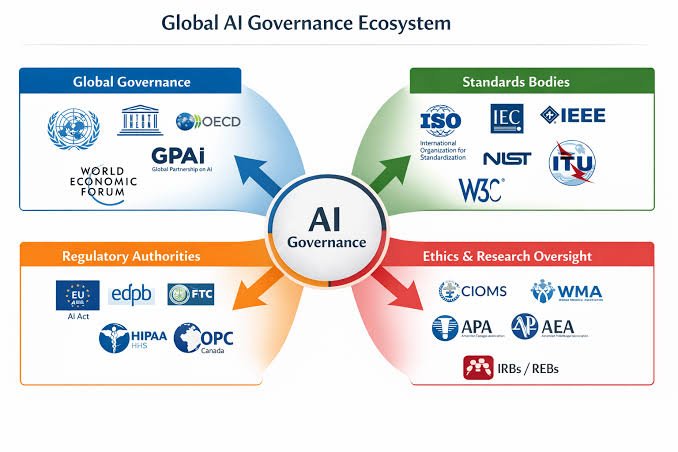
Different countries and regions are developing their own approaches to AI regulation. For example, the European Union’s AI Act establishes rules for AI systems based on different levels of risk, with particular requirements applying to certain high-risk applications. Other jurisdictions may rely on a combination of existing laws, sector-specific rules, and emerging AI policies.
Organizations operating internationally must understand which requirements apply to their activities, customers, and locations. They should also keep track of regulatory changes rather than assuming that one policy will remain suitable everywhere.
International frameworks can provide useful guidance. The OECD AI Principles emphasize trustworthy AI, while the NIST AI Risk Management Framework offers organizations a structured approach to identifying and managing AI-related risks.
Following a recognized framework does not automatically guarantee legal compliance. Businesses should evaluate their specific circumstances and obtain qualified legal advice when necessary.
The Role of Leadership and Employees
AI governance cannot succeed through technology alone. It requires commitment from organizational leaders and participation from employees across different departments.
Leaders should establish expectations, provide appropriate resources, and demonstrate that responsible AI use is a business priority. They should also encourage employees to report problems without fear of unnecessary punishment.
Employees need practical training that helps them recognize AI limitations, protect sensitive information, identify potentially misleading outputs, and understand when human judgment is necessary.
For example, an employee using an AI writing assistant should know that generated facts may be inaccurate and should verify important claims before publishing them. Similarly, a manager using AI-generated recommendations should consider the context and available evidence instead of accepting every suggestion automatically.
A strong governance culture makes responsible AI use part of everyday work rather than a policy that exists only on paper.
The Future of AI Governance
The future of AI governance will likely involve more advanced monitoring tools, clearer organizational standards, and stronger cooperation between governments, businesses, researchers, and civil society.
As AI becomes more capable and widely available, organizations will need governance systems that can adapt to changing technology. This may include automated risk monitoring, improved auditing methods, better documentation, and more effective ways to evaluate AI-generated decisions.
Generative AI also creates new governance concerns, including misinformation, intellectual property disputes, confidential data exposure, and uncertainty about the accuracy of generated content. Organizations will need practical policies that address these issues without preventing useful applications.
Another important development will be the integration of governance into the entire AI development process. Instead of checking for risks only after a product has been created, companies will increasingly need to consider privacy, fairness, security, and accountability during planning, design, testing, and deployment.
Ultimately, successful AI governance will depend on combining effective technology with responsible human judgment. No single policy or tool can eliminate every risk, but consistent evaluation and improvement can make AI systems more trustworthy.
Conclusion
AI governance is becoming an essential part of responsible digital transformation. It helps organizations manage the risks associated with artificial intelligence while supporting innovation, protecting sensitive information, improving accountability, and building public trust.
By focusing on transparency, fairness, privacy, reliability, and human oversight, businesses can create a stronger foundation for using AI effectively. They can also reduce the likelihood of costly mistakes and prepare for changing legal and technological expectations.
The most important point is that AI governance should not be viewed as a barrier to progress. It is a practical way to make progress more sustainable and responsible. As artificial intelligence continues to influence important decisions across society, organizations that take governance seriously will be better prepared to use this technology thoughtfully and earn the confidence of the people who depend on it.